
होमKabaddiCommonwealth Kabaddi Championship 2026: India Open Against England in Ahmedabad — the Real Question Is Depth, Not the Scoreline
Kabaddi
Commonwealth Kabaddi Championship 2026: India Open Against England in Ahmedabad — the Real Question Is Depth, Not the Scoreline
कॉमनवेल्थ कबड्डी चैंपियनशिप 2026 का चौथा मुकाबला आज शाम अहमदाबाद में भारत और इंग्लैंड के बीच खेला जाएगा। यह टूर्नामेंट में भारत का पहला मुकाबला है। भारत ने कई प्रमुख खिलाड़ियों को आराम देकर युवा टीम उतारी है; सुरजीत सिंह कप्तान और नवीन कुमार उपकप्तान हैं। भारत की बताई गई प्रमुख प्रतिद्वंद्वी टीमें ईरान और चीनी ताइपे इस आयोजन में नहीं खेल रही हैं, इसलिए इस मैच का परिणाम भारत की असली ताकत का पैमाना नहीं है। उपलब्ध सार्वजनिक जानकारी में कोई रेड/टैकल आंकड़ा, प्रसारण अधिकार धारक या स्पॉन्सर का नाम नहीं दिया गया है, इसलिए स्कोरलाइन और व्यक्तिगत आंकड़ों को सतर्कता से पढ़ना चाहिए। मूल्यांकन का सही पैमाना यह है कि कितने युवा खिलाड़ी अंतरराष्ट्रीय स्तर के लिए तैयार दिखते हैं।
The fourth match of the Commonwealth Kabaddi Championship 2026 will be played this evening at a sports complex in Ahmedabad, where hosts India face England. It is India's first match of the competition — the tournament's fourth fixture, but the opening game of the hosts' campaign. Indian kabaddi fans are excited about the contest, but one point must be made clear before anything else: the publicly available information contains no data at all that could establish either team's actual strength. There are no raid points, no successful raid percentage, no tackle efficiency, no head-to-head record, and no recent form for any player. What is available is essentially a live-viewing guide, not a competitive analysis.
Tactically, the biggest story of this match is not the scoreline but team selection. India are not fielding their strongest side in this tournament. Several key players have been rested and a large number of young players are being given opportunities. That means India's objective is not margin of victory but discovering squad depth — it is a talent audit. The correct evaluation of this match is therefore how many new caps look ready for international level, not by how many points India win. In other words, the result is not proof of India's real strength; it is only the start of a process.
The leadership structure also carries a signal. Surjeet Singh has been named captain and Naveen Kumar vice-captain — a structure that looks like an experienced spine with young players around it: continuity in leadership, experimentation elsewhere. One transparency note is necessary: 'Surjeet Singh' and 'Naveen Kumar' are names shared by several players in Indian kabaddi, and the available information does not state any player's state or franchise affiliation. Linking these names to a specific professional-league player and making claims about role or calibre would therefore be premature. If the vice-captain is a specialist raider, it may indicate that scoring responsibility in this tournament rests on one proven raider, with the young players rotating around him.
The opposition is England. England's men's programme rests largely on the British Punjabi diaspora and has established an international presence, but its competitive ceiling is well below Iran's and below the Asian top tier. It is reasonable to assume that England's realistic objective in this fixture is not a result but damage limitation and technical credibility — that is, avoiding an early cascade of All Outs.
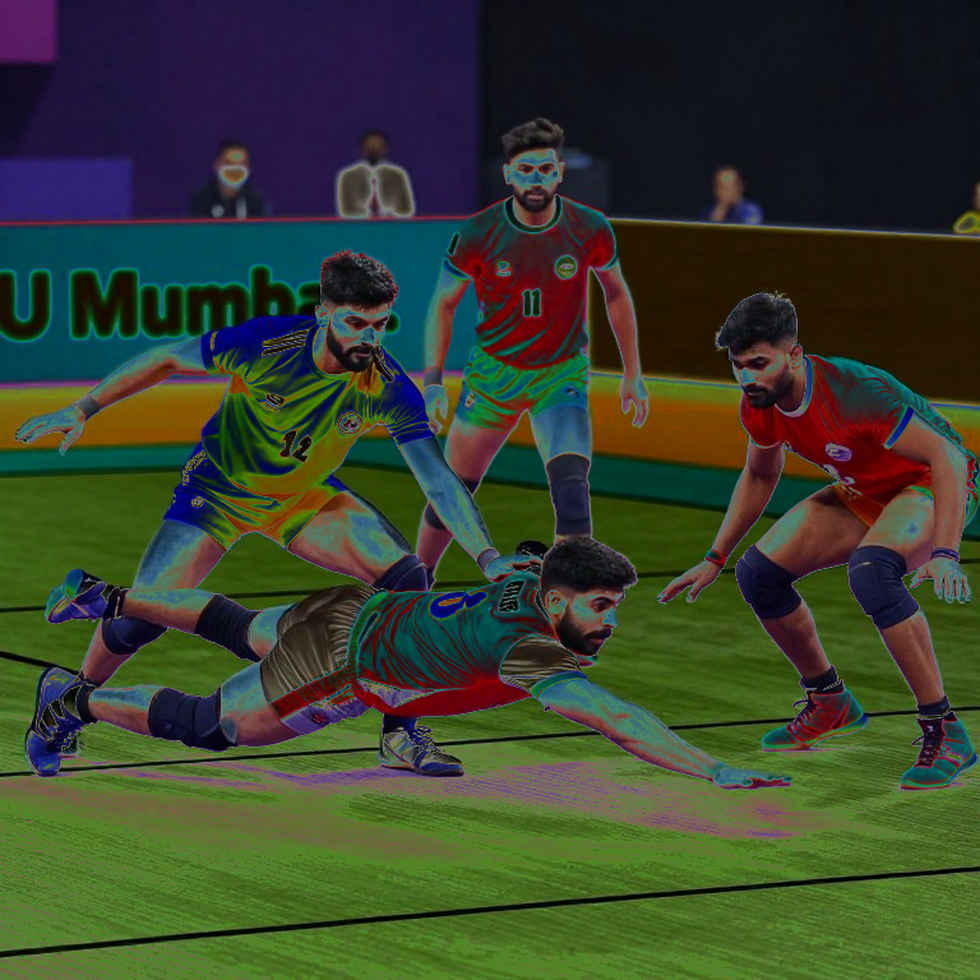
Understanding this match requires knowing kabaddi's basic structure, because there is no rule exposition at all in the available material — a clear sign that the text was written for South Asian readers who already know the sport. Kabaddi is played on a 13m by 10m court with seven players a side, with offence and defence alternating. The raider enters the opponents' half within 30 seconds, scores by touching one or more defenders, and must return to his own half for the point to count. The defending side scores by collectively stopping the raider. Throughout the raid the raider must chant 'kabaddi, kabaddi' continuously, proving he has not held his breath — the sport's most distinctive rule and its greatest source of tension. A bonus line sits deep in the opponents' half, worth one point when the defending side has six or more players on court. When every player on one side has been ruled out, the opposition gets two bonus points and the whole team is revived — the All Out. After two consecutive empty raids, the third becomes do-or-die: score or be out. And a tackle completed while the defending side has three or fewer players on court is a Super Tackle, worth two points.
These rules bear directly on this fixture. Against a weaker opponent, Indian raiders' touch efficiency may produce early All Outs — but each All Out also hands the opposition two points and a full revival. The consequence is that scorelines in such matches systematically overstate the winner's true level. The bonus line similarly inflates individual raid statistics: crossing it is technically undemanding but makes the numbers misleading. The do-or-die rule ensures that even in a lopsided match a player cannot simply run down the clock, so this tournament's data does say something about individual decisiveness — but only against weak opposition. And with 30-second raids and two 20-minute halves, small-sample volatility is high. One strong half can produce an eye-catching individual stat line that says little about season-level ability.
The decisive fact about the competition is that India's named major rivals — Iran and Chinese Taipei — are not playing. The direct implication is that the second-strongest side in the field is materially weaker than the standard needed to test India. In that situation, even winning the title becomes a low-information achievement. There is also an interesting tension in the framing: the available material says at once that India's major rivals are absent, and that India must deliver their best performance and that 'unexpected results are always possible'. In the abstract both can be true, but placed together they inflate a low-stakes fixture into a high-stakes narrative.
The 'Commonwealth' label also warrants caution. Kabaddi is not a Commonwealth Games sport, and a 'Commonwealth Kabaddi Championship' is not an established top-tier property on the level of the Asian Games or the IKF World Cup. Its sanctioning body and history are not stated anywhere in the available material. Note also that Chinese Taipei is a genuine power in women's kabaddi, not in the men's game; describing them as a 'major rival' of the men's team suggests either conflation with the women's game or a loose use of the word. One further nuance: the available material refers to an Asian Games gold won against Iran, but that claim requires independent verification — it should be read as a sourced claim, not an established fact.
The cultural and regional background is the key to understanding this event. After cricket, kabaddi is the most-watched sports property in India, and it carries a rural, indigenous, pre-colonial identity that makes it a vehicle for national pride. Most Indian kabaddi players come from rural, low-income households, and the sport has been a genuine route to social mobility. 'Young players given a chance' is therefore not a neutral selection note but a social narrative in Indian media — and it should be read separately from the numbers. The host is Gujarat, with strong sports-infrastructure ambitions and an event-hosting agenda; such an event also fits a state-branding purpose. The diaspora angle matters too: Punjabi communities in the UK, Canada, Australia and the Gulf supply audiences, ticket buyers and streamers for events of this kind.
One large absence runs through the whole framework — there is no mention of women's kabaddi. India's men's game has a strong professional cycle in the shape of the pro league, while there is no league structure of that scale for women, even though women's kabaddi has genuine depth internationally. Over the long term this imbalance is a risk for both the talent pipeline and internationalisation.
The commercial picture is unclear. The available material names no broadcast rights holder, platform or channel, and no title sponsor or presenting partner. That non-disclosure is itself a signal that the rights carry low value. The article's actual commercial function is to capture search intent such as 'where to watch live streaming' — it is traffic-driven content, not rights-driven coverage.
The practical advice for viewers is to watch the match with two lenses. First, process: which young raiders make decisions under pressure, who shows the courage to go deep rather than settling for the bonus line, and whether new players can hold defensive structure. Second, restraint: do not treat the scoreline as proof of strength, because the rule mechanics themselves favour the stronger side. Claims that a young player 'announced himself' at this event are not established by its data; they are narrative, not evidence. The true benchmark for India's strength remains the pro league, not this event.
The conclusion is simple. India are strong favourites and should win, but the only thing that win will establish is squad depth. The real test comes in the semi-final or final against the strongest remaining opponent — and the only valid comparison for India's actual standing will be a full-strength fixture against Iran. Until then, this Ahmedabad match is an audition, not a final.
संबंधित खिलाड़ी
अनुशंसित
Kabaddi: From Mud Courts to the Professional Era, a Sport's Structural Shift2026-10-31
India vs England, Match 4 — In Ahmedabad, the Real Test Won't Be Written on the Scoreboard2026-10-25
Commonwealth Kabaddi Championship 2026: The Real Statement Sits Between England's 68 and 262026-11-02
The Real Auction Document Is a Shoulder: Reading Kabaddi's Transfer Market Like a Ledger2026-11-02
Before India vs Uganda: The 26-Point Column Inside the 46–26 Win, and the 'Asian Games 2026' Fact2026-10-25
Kabaddi's Unkept Ledger: From the Mud Akhada to the Auction Stage2026-10-26
Kabaddi: From the Clay Court to a Global League2026-11-02
अनुशंसित
The Third Raid, the Bonus Line and the Payroll Queue: Where Kabaddi's Real Ledger Is Kept2026-10-25
Two Losses, One Question: When Did Iran Become India's Co-Favourite in Kabaddi2026-11-02
Kabaddi's Real Scoreboard: The Ledger Moved First, the Stadium Confirmed Later2026-10-25
Kabaddi: From the Clay Court to a Global League2026-11-02
Day One in Ahmedabad: The Commonwealth Kabaddi Championship Points Table That Is Really a Shard of Glass2026-10-25
Before India vs Uganda: The 26-Point Column Inside the 46–26 Win, and the 'Asian Games 2026' Fact2026-10-25
Kabaddi's Auction: The Bids Go to Raiders, the Finals Go to the Corner2026-11-01