
Kabaddi
Kabaddi: From the Mud Akhada to the Asian Games — The Full Anatomy of a Sport
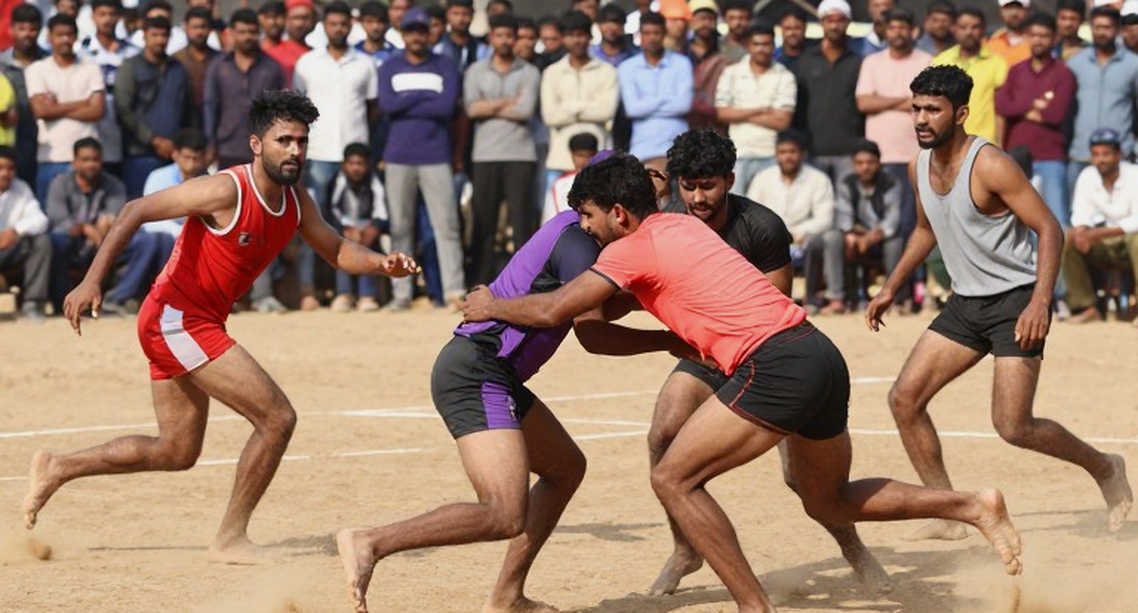
कबड्डी क्या है? कबड्डी एक संपर्क-आधारित टीम खेल है जिसमें सात खिलाड़ियों की दो टीमें होती हैं। एक रेडर विपक्षी आधे हिस्से में जाकर 30 सेकंड के भीतर डिफेंडरों को छूकर अंक बनाता है और लौटता है; पकड़े जाने पर वह आउट होता है। पुरुषों का मैदान 13x10 मीटर और महिलाओं का 12x8 मीटर होता है। टच पॉइंट, बोनस लाइन और ऑल आउट (2 अंक) से स्कोर बनता है। पुरुष कबड्डी 1990 बीजिंग से और महिला कबड्डी 2010 ग्वांगझू से एशियाई खेलों का हिस्सा है। भारत में प्रो कबड्डी लीग 2014 में शुरू हुई। ईरान पुरुष वर्ग की प्रमुख प्रतिद्वंद्वी टीम है।
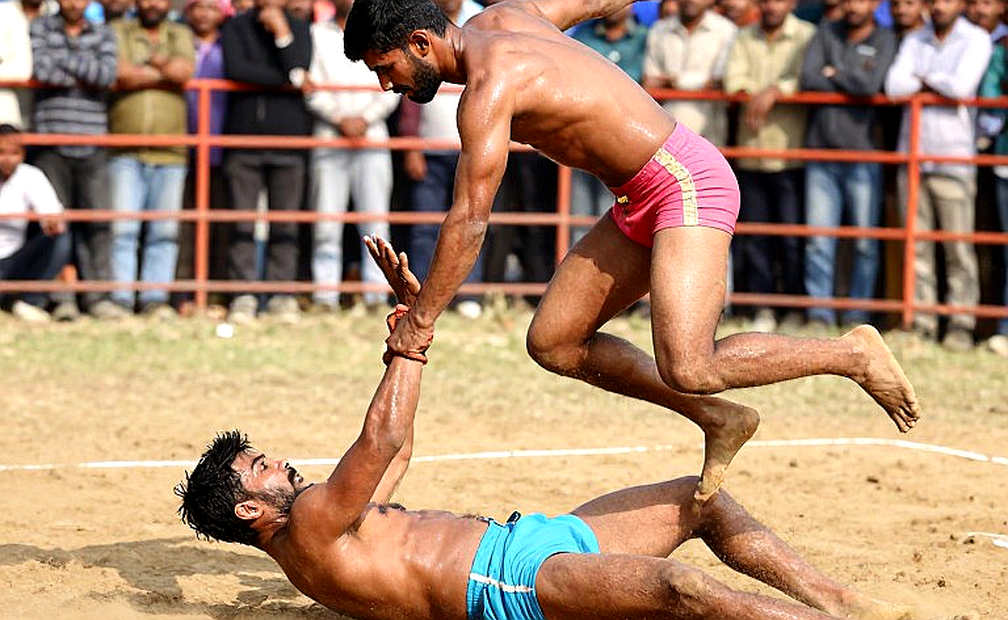
Kabaddi belongs to that small group of sports whose roots lie not in a modern federation's office but in the open mud akhadas of villages. The game has been played across the Indian subcontinent for centuries, and only in the second half of the twentieth century was it brought into the fold of codified rules, organised competitions and broadcast. Today kabaddi is a permanent part of the Asian Games, it has its own World Cup, and in India it has a fully professional, television-driven avatar in the Pro Kabaddi League. Yet despite all this evolution, the core logic of the sport remains what it was centuries ago: one player must hold his breath, cross into enemy territory, touch someone, and come back alive.
The etymology of the name is disputed. One widely repeated explanation traces it to the Tamil 'kai-pidi', meaning 'to hold hands'. Another links it to the chant of 'kabaddi-kabaddi' that a raider repeats to keep count of his breath. In India the game is known by different names in different regions — hututu, chedugudu, sadugudu, kaun bada and several other local forms. This regional variety itself indicates that the sport did not originate in one place and spread, but developed in parallel in many.
The structure of modern competitive kabaddi is clean and bounded. The men's court is 13 metres long and 10 metres wide, while the women's court is 12 by 8 metres. The court is divided in half, and each half carries a bonus line drawn one metre from the mid-line. A squad has 12 players, of whom seven are on the mat at any time and five sit outside as substitutes. A match has two halves of 20 minutes each with a five-minute break. Each team gets three time-outs per half — two of 90 seconds and one of 30 seconds.
The raid is the centre of the sport. Teams alternate sending a raider, who must enter the opposition half, touch at least one defender and return. A raid has a total duration of 30 seconds, during which the raider must continuously chant 'kabaddi kabaddi'; if his breath breaks or the chant stops, he is out immediately. This provision turns the sport into an unusual physical examination: the raider must simultaneously sustain speed, rapid decision-making and controlled breathing.
Points can be scored in several ways. The most common is the touch point — if the raider touches a defender and returns, he scores one point and the touched defender is out. If the raider touches the bonus line while at least six opposing players are on the mat, he earns an additional point. If a raider is caught by defenders and fails to reach his own half, he is out and the opposing team scores a point. When all seven players of a team are out, an 'all out' occurs — the opposition gets two points and all the eliminated players return to the mat. In the Indian subcontinent this situation is also called 'lona'.
Another important provision is the 'do-or-die raid'. If a team fails to score in two consecutive raids, the third raid must yield a point — failing which the raider is deemed out. The rule was introduced to keep the game moving and prevent passive play, and in modern professional kabaddi it has become the biggest pressure point in strategy.
Raiding technique has an entire vocabulary. In a toe touch the raider flicks a toe at a defender and turns immediately. A hand touch uses the arm. A kick delivers a strike with the leg. In a dubki the raider ducks low and tries to slip between defenders' legs. In a running hand touch the raider maintains momentum while making contact. Escape techniques include the lion jump, frog jump and running kona, in which the raider abruptly changes the direction of his body to slip out of a defensive cordon. In the modern game a raider's value lies not only in scoring points but in reducing the number of defenders — a good raider is one who takes two or three defenders out and weakens the opposing side.
Defence is equally technical. In a chain tackle two or more defenders combine to stop the raider. A thigh hold grabs the raider's thigh, an ankle hold his ankle. In a dash the defender moves straight forward to prevent the raider from crossing the mid-line. In a block the defender forms a wall of the body to close the path. The central challenge of defence is that a defender must be aggressive and balanced at the same time — stepping too far forward lets the raider touch and escape, staying too far back lets the raider reach the bonus line.
Balance is the most important element of team strategy. A side typically fields three specialist raiders, three specialist defenders and one all-rounder, though in modern league kabaddi this division has become flexible. The positions on the mat — right corner, left corner, cover and centre — determine how the defensive formation is built. Corner defenders are usually the most experienced, because they carry the heaviest burden of stopping raiders.
In terms of physical demand kabaddi is an exceptional sport. A single 30-second raid is an effort in which anaerobic capacity, explosive power, balance and decision speed all operate at once. A raider must decide within two or three seconds which defender to attack and from which direction to exit. A defender must read the raider's movement in the same window. Research indicates that kabaddi players must place equal emphasis on muscular strength, flexibility and cardiorespiratory capacity — which is why weight training, plyometrics, yoga and sprint drills run together in preparation.
The risk of injury is tied to this intensity. Knees, ankles and shoulders are most affected, because the body stops suddenly and is rotated during tackles. Modern teams now routinely use pre-season screening, movement assessment and individualised recovery plans, but the contact nature of the sport makes injury impossible to eliminate entirely.
Internationally, the biggest stage for kabaddi is the Asian Games. Men's kabaddi was first granted official status at the 2026 Beijing Asian Games, and women's kabaddi was added at the 2026 Guangzhou Asian Games. Beyond these, there are competitions such as the Asian Kabaddi Championship, the South Asian Games and the Kabaddi World Cup. The World Cup has been held since 2026 and features countries including Iran, South Korea, Japan, Thailand, Kenya, Poland and Great Britain alongside India.
The India-Iran rivalry is the most defining story of the sport. For decades India remained almost unbeatable in men's kabaddi, but Iran closed the gap rapidly through systematic training and long-term planning. At the 2026 Jakarta Asian Games Iran won men's kabaddi gold, breaking that monopoly, and in subsequent competitions the contest between the two sides has grown even closer. In the women's category India has been a leading force from the early years, with a consistent record at the Asian Games since 2026.
The commercial face of kabaddi in India was created by the Pro Kabaddi League, launched in 2026. The league turned the sport into a television product — franchise teams, auctions, player contracts, stadium audiences and broadcast rights. Its most concrete effect was that kabaddi became a full career for players rather than merely a route to a government job or state-level competition. The league gave visibility to players from smaller towns and rural backgrounds and made support systems such as coaching, physiotherapy and video analysis part of team operations.
The picture of global expansion is mixed. On one hand countries such as Iran, South Korea and Japan have built organised structures; on the other, the sport is still in a base-building phase in much of Africa and Europe. The biggest challenge is that kabaddi's popularity is largely confined to South Asia and its diaspora communities; establishing it in markets with no cultural pre-history of the game will require simplifying rules and building local coaching structures.
Technology is also making inroads. Video review, slow-motion replays and data-driven player evaluation are now part of professional kabaddi. Metrics such as raid success rate, tackle success rate, average points per raid and count of defensive errors are used directly in team selection and strategy. The shift is moving the sport from experience-based to data-based decision-making.
Through all of this, one thing remains unchanged. Every form of kabaddi — the mud akhada of a village or an air-conditioned stadium — rests on the same basic equation: limited breath, limited time, and a decision that must be made in a tenth of a second. Modernisation does not alter these conditions; it only makes them measurable. And perhaps that is why an ancient rural game can still hold a television audience — there is no hidden technology in it, only open, instantly visible physical duel.
संबंधित खिलाड़ी
अनुशंसित
India vs England, Match 4: Don't Read the Margin, Read the Bonus-Line Ledger2026-10-25
Kabaddi's Unkept Ledger: From the Mud Akhada to the Auction Stage2026-10-26
The Empty Kabaddi Template: Where Facts Go Missing, Folklore Fills In2026-10-24
India vs England, Match 4: In Ahmedabad the Real Story Is the Rotation, Not the Scoreline — and the 'Favourite' Tag Arrives Without a Single Number2026-10-29
Match 4 in Ahmedabad, India's First: Where Rotation and Absences Speak Louder Than the Scoreboard2026-10-30
Two Losses, One Question: When Did Iran Become India's Co-Favourite in Kabaddi2026-11-02
Commonwealth Kabaddi 2026: India's Real Test Is Iran, Not Nigeria2026-10-27
अनुशंसित
In Kabaddi's Numbers, the Missing Part Is the Story2026-11-02
Kabaddi's Real Scoreboard: The Ledger Moved First, the Stadium Confirmed Later2026-10-25
Two Losses, One Question: When Did Iran Become India's Co-Favourite in Kabaddi2026-11-02
India vs England, Match 4 — In Ahmedabad, the Real Test Won't Be Written on the Scoreboard2026-10-25
India vs England, Commonwealth Kabaddi Championship 2026: In Ahmedabad I Will Read the Tape and the Recovery Window, Not the Scoreboard2026-10-28