
Field Hockey
The Shootout Won the Trophy; the Penalty Corner Won the Match
**मुख्य उत्तर**: मलेशिया ने सुल्तान ऑफ जोहोर कप 2026 का फाइनल पेनल्टी शूटआउट में पाकिस्तान को 4-3 से हराया, जब निर्धारित समय तक स्कोर 2-2 बराबर था। मलेशिया ने पांच में से चार शूटआउट प्रयास बदले, पाकिस्तान तीन ही बदल सका। **मुख्य तथ्य**: - फाइनल तमन दया हॉकी स्टेडियम, जोहोर बाहरू में खेला गया और निर्धारित समय 2-2 पर समाप्त हुआ। - पाकिस्तान ने 19वें मिनट में वलीद राणा के पेनल्टी कॉर्नर और 21वें मिनट में मुहम्मद उस्मान के फील्ड गोल से 2-0 की बढ़त ली। - मलेशिया के दोनों गोल पेनल्टी कॉर्नर से आए: मोहम्मद आदम जोहारी (25वां मिनट) और धीरेश गुणसेलन (49वां मिनट)। - शूटआउट में मलेशिया 4/5 और पाकिस्तान 3/5 रहा; हम्जा फैयाज पहला तथा मुहम्मद अम्माद पांचवां प्रयास चूके। - मैच के चार गोलों में तीन पेनल्टी कॉर्नर से आए, यानी 75 प्रतिशत। **स्रोत**: सुल्तान ऑफ जोहोर कप 2026 फाइनल मैच रिपोर्ट, तमन दया हॉकी स्टेडियम, जोहोर बाहरू, 2026 सत्र। **संबंधित प्रश्न-उत्तर**: प्रश्न: सुल्तान ऑफ जोहोर कप 2026 का खिताब किसने जीता? उत्तर: मलेशिया ने पेनल्टी शूटआउट में पाकिस्तान को 4-3 से हराकर खिताब जीता। प्रश्न: फाइनल में पाकिस्तान की बढ़त कब टूटी? उत्तर: 49वें मिनट में धीरेश गुणसेलन के पेनल्टी कॉर्नर गोल से स्कोर 2-2 हुआ। प्रश्न: शूटआउट का अंतर किस प्रयास से बना? उत्तर: पहले राउंड में हम्जा फैयाज की चूक ने पाकिस्तान को पूरे शूटआउट में पिछड़ने पर मजबूर किया।
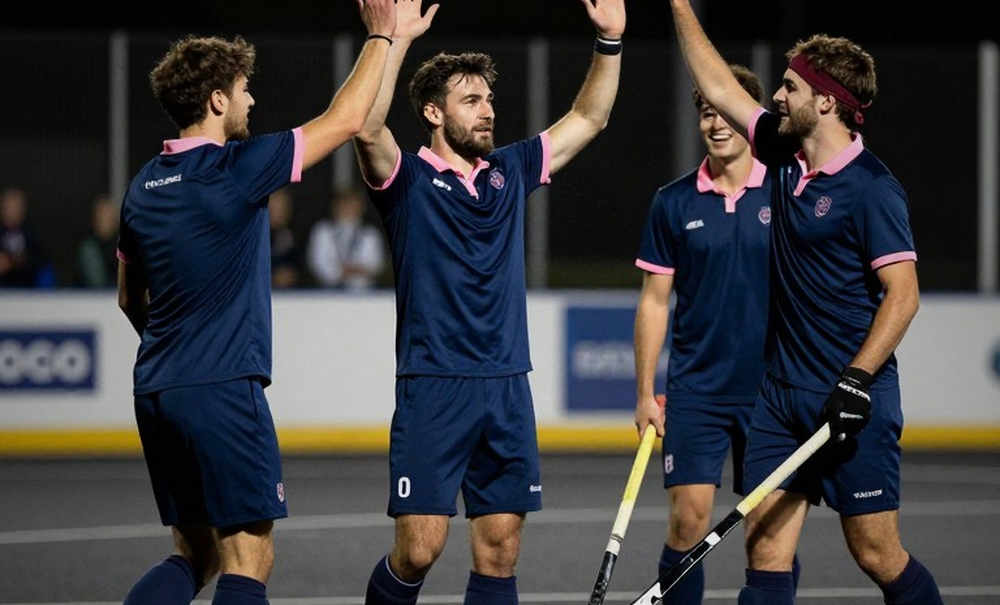
Muhammad Ammad walked to the 23-metre line with the noise already organised into a rhythm — rising on every Malaysian attempt, falling on every Pakistani one. Aferullsyah had just buried Malaysia's fifth to make it 4-3. Ammad had one route left to sudden death. The ball reached the goalkeeper and stopped there, and the Sultan of Johor Cup 2026 stayed in Johor Bahru.
The 4-3 on the board was the trophy's number, not the match's. Four goals were scored in sixty minutes and three of them came from penalty corners — 75 per cent. Both Malaysian goals were set-piece goals; Pakistan got one from a PC and one from open play. The shootout decided the silverware. The penalty corner decided the contest.
The Sultan of Johor Cup is an under-21 invitational run by the Malaysian Hockey Confederation. Its real product is not a trophy but a calendar: the host nation buys its junior squad seven or eight international matches a year, and that purchase is the actual subsidy to its pipeline. On Saturday evening at Taman Daya the subsidy showed up on the field — the hosts went 2-0 down in a final and came back.
Pakistan reaching that final is a data point in itself. The domestic structure at home has been broken for years and the senior side struggles through qualifiers, yet players keep appearing at under-21 level. Both things are true at once, and that is what makes this final bigger than a final: it is the question of whether talent supply or institutional capacity decides an international result.
The shape of the match was visible early. The first quarter ended goalless, both teams reading each other's press, neither willing to leave its left-half channel open.
In the 19th minute Waleed Rana converted a penalty corner and two minutes later Muhammad Usman scored from open play to make it 2-0. That two-minute double was the decisive event of the final, because everything after it collapsed into one question: could Pakistan manage a lead? Usman's goal came from the field, which means Malaysia's press broke once and was punished immediately.
Malaysia answered in the 25th minute through Mohammad Adam Johari from a penalty corner. Half-time, 2-1. From the 26th to the 48th minute — twenty-three minutes — the score did not move. That window is where the match is actually audited. Pakistan held a one-goal lead and did not extend it; Malaysia accumulated penalty-corner pressure through that stretch and equalised in the 49th minute when Dheeressh Gunaseelan converted a PC.
When I built my first possession-to-PC database for the 2026 Hockey India League final studio, a pattern surfaced: a team that takes a lead and does not lift its PC rate in the next fifteen minutes tends to have that lead dissolved by a corner in the following quarter. Johor Bahru repeated the pattern. I watched this final from Brisbane with the PC log on a second screen, and by the 40th minute the log had already said what the scoreboard had not — Pakistan was not moving from 1-0 to 2-0. It was retreating.
I mapped every possession to a PC and found the ghost in the machine. Malaysia's two goals came from the same rehearsed mechanism — pusher's angle, flicker's timing, a third man stationed for the rebound — the kind of routine that costs months of junior practice. Pakistan split its scoring between one corner and one field goal, which means its game leaned on open play. Open play builds a lead. Set pieces close a match.
The shootout arithmetic tells a separate story. Ten attempts produced seven goals, 70 per cent. Malaysia converted four of five (80 per cent), Pakistan three of five (60 per cent). Adam Johari put the first one in; Hamza Fayyaz missed his. Pakistan then converted three of their remaining four — 75 per cent, good by any standard — and still lost. The reason is structural: in a five-attempt format, the side that falls behind in round one has to convert every remaining attempt and live on the hope of one save. Waleed Rana made it 3-3 in round four, but Pakistan had not led once. A shootout is just a probability model wearing a jersey, and the model did exactly what the model does.
Every match is a system; the scoreline is one output variable. Here the system produced its output in two places — Pakistan's ball retention between the 21st and 49th minutes, and the second phase of Malaysia's corner defence. The hosts equalised in the 49th, which left them eleven minutes to find a winner and no corner to show for it. The match did not finish in regulation. Control had already moved.
Explaining this as home-crowd energy is easy and wrong. The crowd did not score; both equalising goals came off the routine rehearsed for weeks on the Taman Daya practice turf. The noise was the crowd's contribution. The result was the mechanism's. Calling Pakistan's defeat a failure of nerve is the other convenient read — converting three of five is not what panic looks like. In a format where the first attempt carries double weight, the first miss is the margin.
The claim that Pakistani hockey is back needs a dashboard. Reaching an under-21 final is evidence of supply, not of a system. Until this cohort is given twenty-five-plus competitive matches a year, it remains a specimen rather than a structure. For Malaysia, the title's value gets settled over the next eighteen months: whether three of these players earn senior caps. A pipeline pays out in caps, not in trophies.
The trophy was the verdict of one Saturday evening. The next four years will be decided by a calendar, and nobody has printed that calendar yet.
संबंधित खिलाड़ी
अनुशंसित
Twenty Editions, One Ledger: Trinity–Thomian Settles Its Accounts on Colombo Turf2026-10-25
Sultan of Johor Cup 2026: Malaysia beat Pakistan 4-3 in the shootout, but the final was decided in the 39 minutes after the 21st2026-10-25
The 20th Trinity–Thomian Hockey Encounter: A Trophy Was Lifted, the Columns Stayed Empty2026-10-25
The Twentieth Clash, One Shared Heartbeat: The 2-2 Saga of Trinity–Thomian Hockey2026-10-25
The Shootout Won the Trophy; the Penalty Corner Won the Match2026-10-25
Sultan of Johor Cup 2026: Malaysia beat Pakistan 4-3 on penalties after 2-2 final2026-10-25
Sultan of Johor Cup 2026 Final: Malaysia Win 4-3 on Shootout, Three of Four Regulation Goals Came From Penalty Corners2026-10-25
अनुशंसित
20th Trinity–Thomian Hockey Encounter on Colombo's Astro Turf: The Reel Kept the Moments, the Ledger Kept the Questions2026-10-25
The Twentieth Clash, One Shared Heartbeat: The 2-2 Saga of Trinity–Thomian Hockey2026-10-25
Seven Days, Five Matches, Two Back-to-Backs: Bangladesh's Real Test Is the Schedule, Not the Tactics2026-10-24
Twenty Editions, One Ledger: Trinity–Thomian Settles Its Accounts on Colombo Turf2026-10-25
20th Trinity–Thomian Hockey Encounter: A Night of Passion and System on the Astro Turf in Colombo2026-10-25